



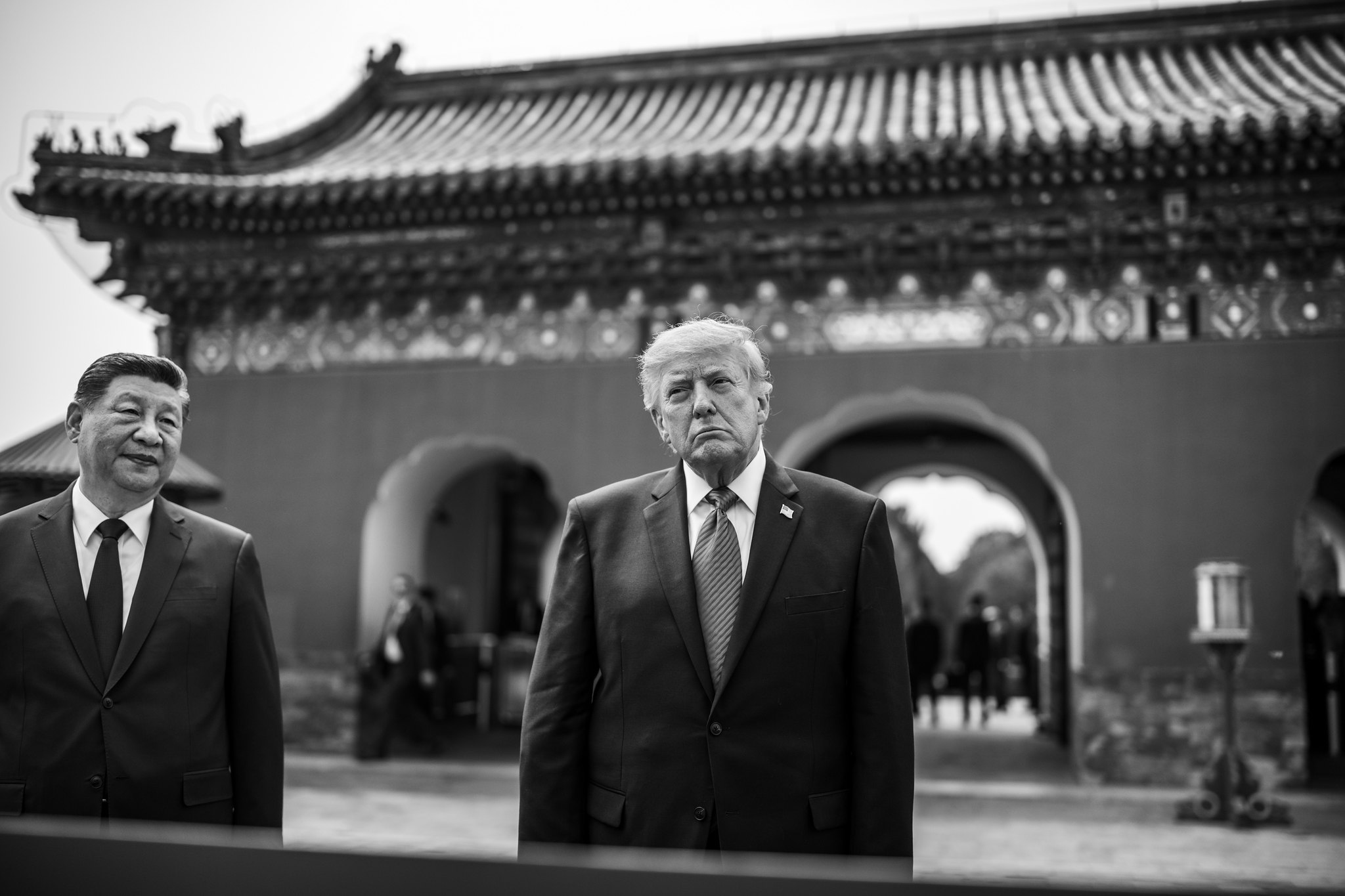
When U.S. President Donald Trump traveled to Beijing last week for a state visit with Chinese President Xi Jinping, the two leaders faced months of expectations about potential deal-making and bilateral problem solving. Science and technology (S&T) issues from supply chains and export controls to AI safety and national security loomed large. DigiChina asked a group of specialists in U.S.–China S&T ties what they saw coming out of the visit, as well as what important matters appeared to go unaddressed. They analyze the uncertain promise of newly announced channels for consultation and dialogue, identify crucial unresolved issues heading into the leaders’ next expected meeting in September, and explain what they will be watching for semiconductors, Taiwan, and beyond.
JUNMIN WANG
Professor of Sociology, University of Memphis
The Trump-Xi summit appeared unexciting and almost unfruitful on the core battlefield of science and technology (S&T) between the United States and China, with no major breakthroughs and only a few trade deals that were remotely relevant to S&T. The summit made incremental progress on the two governments’ mutual de-escalation efforts over the past six months, pulling further away from their dizzying, neck-to-neck confrontations in spring 2025.
With its continuously stringent control over high-end AI chips, advanced lithography equipment, and military technologies, the United States eased some export controls on AI chips (e.g., Nvidia’s H200) and deregulated trade in mid-range chips and equipment with China. For its part, China suspended export controls on rare earths and critical minerals until November 2026.
One of the summit’s profound yet less eye-catching achievements is the launch of institution-building efforts to address mutual vulnerabilities introduced by the U.S.–China trade and technology wars. The two countries agreed to establish the Board of Trade (贸易理事会) and the Board of Investment (投资理事会) to address future tensions and frictions, with the trade group reportedly to discuss tariff reductions on $30 billion of goods on each side. Institutionalizing negotiations in an effort to avoid “surprise attacks” (突然袭击), may not necessarily enhance trust or guarantee reliability. But it could be a good mechanism to prevent either side from arbitrarily destroying the current truce.
Emerging from the lowest point in the U.S.–China relationship in about half a century, the summit clearly focused less on immediate transactions and more on redefining the long-term relationship as both sides’ appetite for “decoupling” winds down. The two governments have agreed on a new concept for the U.S.–China relationship called “constructive strategic stability” (建设性战略稳定), another incremental update from the terminology of “strategic stability” that the U.S. government adopted in February 2026. Still, whether this “constructive” rhetoric can hold depends on whether the Trump administration maintains the pragmatism built over months leading up to the summit—and for how long.
LIZZI C. LEE
Fellow on Chinese Economy, Asia Society Policy Institute’s Center for China Analysis
The Trump-Xi summit offers a small but revealing glimpse into where Beijing’s tech policy may be headed. China will need to make progress on summit deliverables between now and Xi’s confirmed return visit to Washington in September. Two developments will be especially important.
First, will Beijing actually allow H200 deliveries, and if so, at what scale? The issue is not simply whether Washington approves the licenses. Previous openings around H200 access were effectively dead on arrival, because Beijing slow-walked purchases amid internal debate over whether such access would deepen dependence on U.S. technology. Has China’s domestic chip ecosystem developed enough since then that leaders feel confident H200 access will not hamper localization? Or has the compute shortage become so intense that Beijing is willing to tolerate more opening?
China’s top AI firms want the compute, especially for workloads where domestic capabilities still offer no real substitute. But China’s own security hawks remain suspicious and do not want U.S. chips to become anything more than a short-term bridge as China builds its own AI ecosystem. Actual shipments, volumes, and end-uses will show which bureaucratic camp is gaining ground in China: security hawks or development boosters.
Second, the AI safety protocol discussion is worth watching. Momentum in the days before the summit appears to have been at least partly driven by Anthropic’s limited release of Mythos, which pushed AI risk from abstract, feel-good governance language to a more muscular discussion about cyber vulnerabilities. China’s official response initially treated Mythos with skepticism, viewing its formidable capabilities as U.S. hype or a pretext for restricting Chinese access. But that skepticism has shifted toward concern that powerful agentic systems could create asymmetric risks for China itself. Beijing worries that U.S. firms could develop highly capable cyber technologies, restrict Chinese access to them, and still leave Chinese telecom networks, infrastructure, and logistics systems exposed. That gives China a real incentive to support an AI “best practices” protocol around misuse, cyberattack escalation, and crisis communication.
But Beijing also sees agentic AI as a leapfrog opportunity, so it will likely simultaneously pursue regulatory guardrails and accelerated innovation and deployment of agents. The tension between setting harder rules of the road and pushing faster innovation is now central to China’s AI policy.
AIDAN POWERS-RIGGS
Associate Fellow for China Analysis, iDeas Lab, Center for Strategic and International Studies
The Trump-Xi summit in Beijing underscored Taiwan’s paradoxical position in the AI era. President Xi remains fixated on dictating Taiwan’s political future, but the island’s growing centrality to global supply chains means much of the world is paying more attention to the material stakes of that future. President Trump, by contrast, has sent mixed signals on Taiwan, yet he cannot downgrade U.S. support for the island without imperiling the United States’ own AI ambitions.
TSMC is currently posting record revenues on the back of surging demand for AI chips. U.S. imports from Taiwan recently eclipsed those from China for the first time in decades. And despite geopolitical risks, the world’s leading technology firms continue to flock to the island, driving foreign direct investment to historic highs.
Taiwan’s economic success has thus become its best defense against political marginalization. Without buy-in from Taipei, any attempt to shape the island’s fate, whether from Beijing or Washington, would risk jeopardizing global economic stability.
The unresolved Nvidia H200 dispute shows how difficult it is for either side to escape Taiwan’s gravitational pull. The Trump administration has approved the chips’ sale to Chinese AI firms, but Beijing has so far held up the deal. Chinese leaders have prioritized technological self-reliance, but access to Nvidia’s AI chips would help ease compute constraints facing Chinese firms.
If the deal proceeds, it could accelerate parts of China’s AI ecosystem—but also further embed it within supply chains running through Taiwan. That may make the deal even more difficult for Beijing to accept; reliance on Nvidia can be written off as a temporary necessity, but depending on Taiwan is a reminder of the island’s rising status as an irreplaceable economic linchpin in the AI era.
CORY COMBS
Head of Supply Chain Research & Associate Director of Climate, Energy, Industrial Policy, Trivium China
From a summit stronger on vibes than solutions emerged one critical, concrete opportunity for deeper engagement: movement on the Board of Investment (BOI). For my money, it stands to be a defining mechanism for China-to-U.S. tech transfer.
More critically, the BOI would give the Department of Treasury more dominant influence in negotiations of where China can invest in the United States. It would shape what tech counts as “sensitive” in practice. To Treasury, national security is paramount. But it does not dismiss the potential economic benefits of Chinese investment and tech transfer quite as easily as other key agencies.
Treasury Secretary Bessent, who will chair the BOI, has explicitly said it would “make sure that these [non-sensitive] investments don’t get referred to CFIUS.” That’s significant assurance, given that uncertainty around whether or when the interagency Committee on Foreign Investment in the United States could unwind a deal remains a key holdup for massive amounts of potential U.S.-bound investment.
Plenty of investment focuses are obviously sensitive (biotech, AI) or nonsensitive (most traditional manufacturing, commercial properties not right next to military bases). But what matters is how determinations are made at the boundaries, where different interests argue in different directions. This is where it matters who is running the show.
Case in point: Whither batteries? For use in EVs made by American automakers? What about for industrial power supplies? And...AI data centers? Perhaps Chinese firms can license materials manufacturing technology and even set up factories, but will not get access to the electronics, software, or telemetry?
Private Chinese firms dominate the best lithium-ion technologies, the best emerging sodium-ion batteries, the best emerging hybrid batteries, and the United States is simply not positioned to catch up in the foreseeable future. The BOT is not a licensing mechanism, nor is it likely to clear Chinese frontier battery tech; the BOI is, and it could enable battery tech entry in ways made durable by genuinely addressing national security concerns.
In the meantime, the United States is quickly heading toward being an ICE (internal combustion engine) island—a nation of automakers uncompetitive in EVs and therefore uncompetitive abroad. This is recognized by even the most quintessentially American car giant, Ford, which is actively pursuing a partnership with Chinese battery leader CATL despite pockets of opposition from China hawks.
The United States has many such choices at hand, boiling down to: Where will it and where won’t it invite Chinese tech? How Treasury draws the lines of sensitivity via BOI on batteries and elsewhere will shape key areas of U.S. industrial competitiveness.
PAUL TRIOLO
Honorary Senior Fellow for Technology, Asia Society Policy Institute’s Center for China Analysis (CCA)
The central purpose of the summit was to reaffirm the October 2025 Busan pledge that neither side would take steps the other viewed as major escalations—especially U.S. export controls on semiconductors and equipment and Chinese controls on rare earths, magnets, and critical minerals. That did not appear to happen.
The lack of resolution is itself significant. Asked about formally extending the one-year trade truce reached last November, USTR Jamieson Greer said only, “We’ll see about that…There’s a willingness on both sides.” Meanwhile, U.S. companies already caught between the two countries’ export control regimes will continue to worry about long-term access to essential inputs. If agreement on this core issue slips to September, there are likely major unresolved disagreements inside both Washington and Beijing over the terms of any extension.
The larger question is whether both governments have absorbed the lesson that supply chain weaponization has been overdone. “Escalate to de-escalate” has become a dead end, generating collateral damage without creating stable leverage. Yet some in Washington still argue for more weaponization, assuming rare earth dependence can be solved quickly and painlessly. No and no. That mindset misunderstands the actual interdependence across the Pacific and risks pushing both countries into a cycle in which every control invites retaliation, and every retaliation expands the blast radius for private firms, allies, and global supply chains.
The summit also underscored the need for a real U.S.–China dialogue on frontier AI governance. Anthropic’s Mythos release has sharpened concerns in both capitals about models that could amplify cyber, biosecurity, and loss-of-control risks. Rather than pointing only toward more export controls, the Mythos moment inspires guardrails, crisis channels, and defensive cooperation. Washington should at least consider whether China can be brought under a protective umbrella for defensive uses, rather than leaving a major global actor outside shared mechanisms for hardening critical infrastructure.
In the end, a two-day summit was never going to resolve the structural problems in the relationship. It did not meaningfully strengthen the fragile détente—a goal that will remain elusive unless both presidents manage to restrain hardliners at home.
FEIFEI HUNG
Affiliated Researcher at the Asia Society Policy Institute’s Center for China Analysis (CCA)
As the Trump administration has approached Taiwan transactionally, evident in its use of arms sales as leverage and security commitments as bargaining chips with China, it is leaving Taiwan's fate increasingly subject to the outcomes of bilateral U.S.–China negotiations it has no seat in.
The problem is compounding. If China is reducing its semiconductor dependency while the United States treats Taiwan's security as negotiable, Taiwan's room to maneuver is narrowing from both directions. The more pressing question for Taipei is not what was decided in Beijing, but what unique leverage it holds and how to deploy it.
Taiwan is not entirely passive. The government's N-2 rule, which restricts TSMC from exporting its most advanced process nodes overseas, reflects an awareness that its technological edge requires active protection. But controlling the technology and having a say in how it is used geopolitically are different problems. Closing that gap carries its own risks.
Any move by Taipei that reads as hedging against Washington, particularly under a transactional Trump administration, could itself become a source of friction. Yet dependence on security guarantees from a partner that has shown willingness to negotiate over Taiwan's core interests is not a stable posture either.
In light of Beijing’s increasingly aggressive stance on the Taiwan issue and Washington’s apparent ambivalence toward Taiwan’s security, it’s time for Taipei to enact more policies that defend its interests, even if such maneuvers anger one of both superpowers. If Taipei fails to act, it risks leaving itself vulnerable ahead of the upcoming season of U.S.–China summitry, including Xi’s planned autumn trip to Washington. It won’t have a seat at the stateside table either.


